

Employee connections are critical to long-term loyalty, retention, and productivity. But, many managers fail to understand the crucial link between recognition and connection. Recently O.C. Tanner, released the results of a study that aimed to identify if and how much recognition drove employee connection.
You may be surprised to learn that recognition increases connection for employees at work and the lack of recognition harms relationships. The type of recognition is important. And, how it’s given impacts the strength of the connection which drives employee performance.
Connection Increases Resiliency
When your employees feel connected to their team and to other colleagues, they feel a part of a team. A series of Stanford University studies show that when individuals performing silo tasks are treated as a team, their motivation and persistence increases.
Think about that. Even when individuals working alone believe they are part of a team, they work better. Connection is the driving force behind that. Humans have a need to connect. It’s reflected in our complex social interactions and in our attachments to our pets.
The research by Shawn Anchor at Harvard, and around the world shows that connection increases resiliency, happiness, and lowers stress. Shawn teaches; “Countless studies have found that social relationships are the best guarantee of heightened well-being and lowered stress, both an antidote for depression and a prescription for high performance.”
Connection makes it possible for employees to navigate the stresses and uncertainty of the workplace. This is more critical than ever before as Covid has introduced heightened stress and uncertainty the last two years.
But, the very nature of social distancing made it harder for employees to connect. Plus it’s human nature to retreat during stress. Shawn found that:
“The people who survive stress the best are the ones who actually increase their social investments in the middle of stress, which is the opposite of what most of us do.”
If employers want employees to be more resilient at work, then it’s critical that companies find a way to restore the connection.

Connection Enhances Loyalty
Employees who feel connected to their team enjoy an enhanced level of loyalty to the team. Employees who feel a connection to their employer’s mission and purpose feel increased loyalty to their employer.
Managers who foster both types of connection see improved retention and performance because employees feel loyalty to their organization and to their teammates.
Often employees cite letting down their team as a major reason they delayed leaving an employer. (team building articles for reference) Connection is so important that Gallup asks employees if they “have a best friend at work.” to help gauge employee satisfaction levels.
It’s not hard to understand why. Employees who feel a part of a team gain a greater sense of intrinsic motivation to perform well to help their team. But, they also gain the resiliency and support network during difficult times that makes people do better even when the going gets tough.
This two-way support network: the employee feeling greater responsibility to colleagues and teammates and the support they receive back increases loyalty. It increases the investment an employee has given to work. And, investment helps to increase loyalty because a new employer requires more investment.
And, the opposite appears to be true. Gallup polls have shown that the number one reason employees leave a job is due to their manager. Managers have the power to create connections among teams and to assist employees in feeling connected to their company and job purpose.

Managers Drive or Destroy Connection
Managers yield the power to create connection or destroy it among their team. There are many ways that managers build connections with their employees. Let’s cover five important ways.
Managers Build Connection to Company Goals Through Storytelling
When employees empathize with and feel aligned with company goals, they feel connected to the purpose of their organization. And, they need to connect the dots between their contribution and the success of the company.
Managers communicate the “why” and “how” the company enhances local neighborhoods and improves the world. Consider the impact on laymen when a manager can connect their contributions to the larger contributions of the organization. Here are a few examples:
A janitor that sees his work in a hospital as making it possible for patients to heal faster
An errand boy at NASA who feels like he’s helping in space exploration
A secretary who understands that her voice is the first one to build trust for her non-profit employer
When employees connect to the company values and understand their roles in it’s goals, their connection to the organization increases. Managers play a pivotal role in this process.

Managers Build Connections Through Team Building
Managers build strong teams through team building. But, team building isn’t always an extracurricular activity (here are some great ones). It’s more often the ability for team members to engage with each other, discuss ideas and obstacles, and set team goals.
Strong teams require certain elements to be present. Teams should be able to celebrate success together, but they should also be able to discuss challenges and brainstorm solutions. Strong teams have a sense of autonomy and tools to success that allows them to connect and own their performance, collectively and individually. Check out 5 Important Tools to Building Effective Teams.
Job Growth Builds Connection To the Job
Today’s workforce values education and growth as an integral part of their job. Managers build connections to an employee’s job through both formal and informal growth opportunities. When managers take the time to educate and train employees, they feel a greater connection to their job and employer.
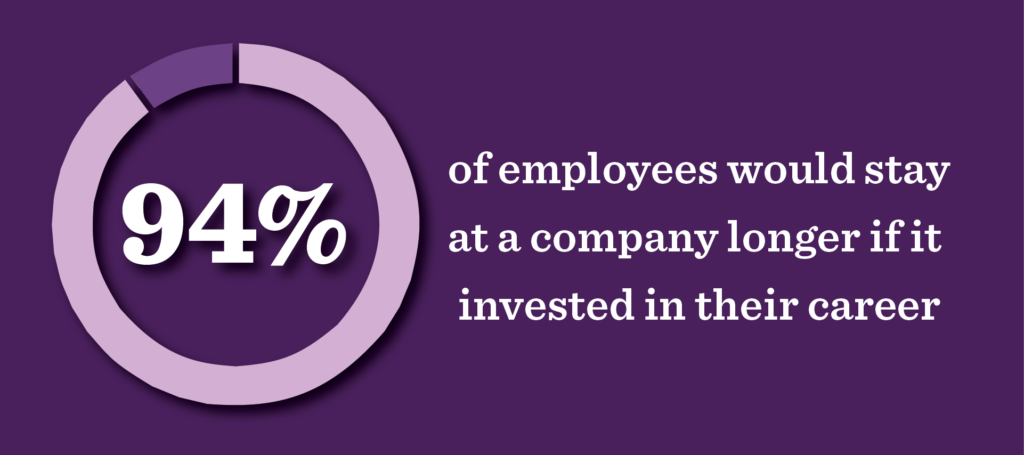
According to the Workplace Learning Report, 94% of employees would stay at a company longer if they invested in their careers. Providing learning opportunities is a way that employers demonstrate loyalty and investment into an employee. That in turn, helps them to build connections back to the employer.
And, managers can help advance employees’ careers even without a big budget. Check out 11 Ways to Invest in Employee’s Professional Development. Growth can come through mentoring, job swapping, and a variety of unique lunch and learn events,
Managers Build Connection Through Recognition
As the O.C. Tanner Culture Report shows recognition builds connection. When managers recognize and express appreciation for employees, their skills, and contributions, they build connections.
By leading in recognition, managers set the team culture. Berne Brown, researcher and professor at the University of Houston, expounds on this idea:
“I defined connection as the energy that exists between people when they feel seen, heard, and valued; When they can give and receive without judgment; and when they derive sustenance and strength from the relationship.”
Recognition is the keyword for when a manager shows that they value an employee. It happens when managers see and hear employees. Managers yield a lot of power, and that includes the ability to destroy connections as well.
Connection Can be Destroyed
Managers have the power to create connection, but can also destroy it. Brigette Hyacinth, author of Leading the Workforce of the Future, cites an experiment shared with her from one employee.
“I got a call my wife had been in a serious car accident. I told my boss I needed to leave immediately. He asked me to give him 10 more minutes. I was so disappointed because he could have covered for me. I come in early. I leave late. I hardly take any sick leave and that was the response I got from him? I looked at him and walked straight out the door. My relationship with my manager went south after that. I started planning my exit strategy and within 3 months, I quit.”
In this situation, the employee did not feel heard or valued. Even if the manager had previously expressed appreciation for his extra efforts, the actions of the manager to really recognize his contributions by allowing him autonomy to leave immediately.
The inability to demonstrate appreciation by granting a small measure of autonomy and trust undermined all previous connections that had been built. And, there was a connection built because the employee had contributed extra to his job regularly by working early and late.
This is further demonstrated in the 2022 Global Culture Report. Connections can be destroyed through a lack of recognition and appreciation. An employee in the exploratory focus groups shared this experience in the culture report;
“He described how he helped another colleague with her project late one Friday night. It was not something he needed to do, nor was he involved in her project. Yet, because they had worked together off and on the past year and she seemed to need help, he helped.
The next week, after her presentation, she recognized various people for their help, but not the member of our focus group, even though much of his work appeared in the presentation. He felt hurt, betrayed, and angry. His response when asked if he would help her in the future? “She can jump in a lake.”
Conclusion
When connections are built at work, employees prosper and succeed. They are better equipped to handle the cyclical ups and downs of their job. They stay longer and are happier at work. Managers directly influence the connections that employees make and can make or break those connections at the workplace.
About Thanks
Thanks is a leading provider of a recognition-based platform that increases communication, builds teamwork, and makes recognition a part of company culture. Fast, easy and simple Thanks makes it easy to bring data-driven employee recognition to your entire organization. O.C. Tanner purchased the Thanks platform in 2019 to fulfill the recognition needs of smaller businesses.
Thanks customers benefit from the same decades of research in employee motivation and company culture that O.C. Tanner enterprise clients enjoy, but in a product that is geared for fast, easy and simple deployment. Whether you’re starting a recognition program or improving and expanding on what you already have, Thanks has everything you need to engage your people with effective, scalable recognition.